Honda Sensing on the CR-V: Every Feature Explained
Honda Sensing is the name Honda gives to the CR-V’s bundle of camera- and radar-based driver-assist systems: automatic emergency braking, forward collision warning, lane keeping, road departure mitigation and adaptive cruise control, plus more on newer models. It has been standard on every US CR-V trim since the 2020 model year; on 2017–2019 models it came on the EX and higher trims only, not the LX.
This guide goes through each feature one at a time: what it does, when it works and when it does not. It also shows which model years and trims have what, so you can check a used CR-V before you buy it.

Honda Sensing Availability by Model Year
The suite has changed a lot since it first appeared on the fifth-generation CR-V. The table below covers US models from 2017 on. “BSI” is Blind Spot Information with Cross Traffic Monitor, which Honda lists alongside Honda Sensing but which is not always part of the standard package.
| Model years | Honda Sensing | Notable features | Blind Spot Information |
|---|---|---|---|
| 2017–2019 | EX, EX-L, Touring (not LX) | CMBS, FCW, RDM with LDW, ACC with Low-Speed Follow, LKAS | EX and above |
| 2020–2022 | Standard on all trims | Same core suite, now on the LX too | EX, EX-L and Touring (not LX) |
| 2023–2025 | Standard on all trims | Adds Traffic Jam Assist and Traffic Sign Recognition | Every trim above the LX |
| 2026 | Standard on all trims | Also lists Driver Attention Monitor and Auto High-Beam as standard | EX and above |
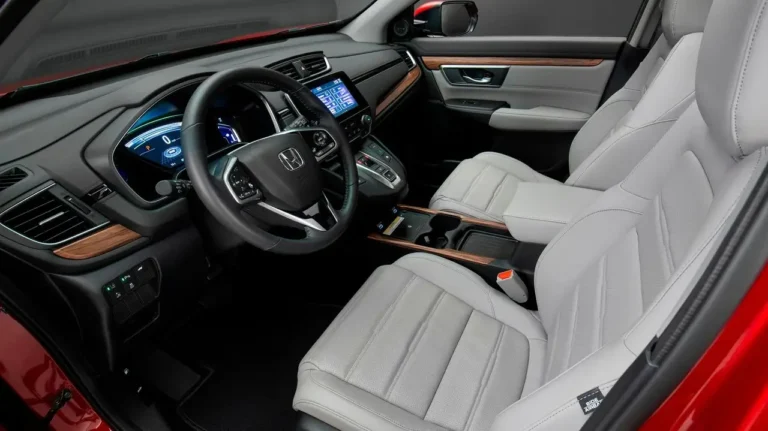
If you are shopping for a used one, the quickest check is the right-hand steering-wheel spoke. If there is a button with a car-and-distance-bars icon (the following-interval button for adaptive cruise), the vehicle has Honda Sensing. Our used Honda CR-V buying guide covers other things to check by year.
Collision and Road-Departure Features
These systems work in the background. You do not have to switch them on, but most can be adjusted or turned off in the vehicle settings menu.
Forward Collision Warning (FCW)
FCW watches the road ahead and gives an audible and visual alert when it judges a collision with a vehicle in front is likely. On most CR-Vs you can set how early the warning comes (long, normal or short) in the driver-assist settings. If you get a lot of false alarms in city traffic, try a shorter setting before you switch the system off.
Collision Mitigation Braking System (CMBS)
CMBS is Honda’s automatic emergency braking. If you do not react to the FCW alert, the system can brake lightly and then hard to avoid a collision or reduce how hard you hit. Honda’s 2020 materials list pedestrian sensing as part of CMBS. Like every system of this kind, it is designed to reduce harm. It will not prevent every collision, especially at higher speeds or with stationary objects at odd angles.
Lane Departure Warning (LDW) and Road Departure Mitigation (RDM)
LDW warns you if the CR-V starts to drift across detected lane markings without a turn signal. RDM goes further: it can apply steering input and, if needed, braking to keep you from leaving the road or crossing a solid line. You will feel RDM as a firm nudge in the steering wheel. Faded paint, snow cover and construction zones all reduce how well it works.
Traffic Sign Recognition (TSR)
Listed as standard from the 2023 model year, TSR reads speed-limit signs and shows the current limit in the driver display. It is a convenience feature, not a speed governor, and it can misread signs on exit ramps or frontage roads.
Blind Spot Information and Cross Traffic Monitor
On trims that have it, BSI lights an indicator near the side mirror when a vehicle is in your blind spot, with an alert if you signal toward it. Cross Traffic Monitor warns of approaching vehicles while you reverse out of a parking space. Check your trim before you rely on it: it has not been fitted to the LX on any generation covered here.
Driver-Assist Features That You Switch On
The steering-assist and cruise features need you to turn them on, usually with the MAIN or cruise button on the steering wheel and then the LKAS button.
Adaptive Cruise Control (ACC) with Low-Speed Follow
ACC holds a set speed and automatically keeps a chosen gap to the vehicle ahead, using the throttle and moderate braking. Low-Speed Follow means it can bring the CR-V to a full stop behind a stopped vehicle and, once you tap the accelerator or the RES/+ switch, pull away again. We cover the buttons, gap settings and real-world limits in detail in our separate CR-V adaptive cruise control guide.
Lane Keeping Assist System (LKAS)
LKAS applies small steering corrections to help keep the CR-V centered between detected lane lines. It is not self-steering. You must keep your hands on the wheel, and the system will warn you and then disengage if it detects no steering input. It works best on highways with clear markings and gentle curves.
Traffic Jam Assist
New for 2023, Traffic Jam Assist extends lane-keeping support to slow traffic. Honda describes it as bringing LKAS benefits to speeds below 45 mph. Combined with ACC Low-Speed Follow, it reduces the workload of stop-and-go highway traffic. It does not let you take your attention off the road.
Other Systems You May See Listed
- Auto High-Beam: switches between high and low beams based on oncoming and leading traffic. Listed as standard on 2026 models.
- Driver Attention Monitor: estimates driver fatigue from steering inputs and suggests a break when needed. Listed as standard on 2026 models.
- Low-Speed Braking Control and parking sensors: available on select trims; these use sonar sensors to warn of, and in some cases brake for, obstacles while parking.
For an overview of the CR-V’s broader tech (screens, connectivity, audio), see our Honda CR-V technology features article.
How to Adjust or Turn Off Honda Sensing Features
Menu names vary slightly between the 7-inch and 9-inch screens and between generations, but the general path is the same.
- Park the CR-V and put the power mode in ON.
- Open the settings menu on the touchscreen (or use the steering-wheel controls and the driver information display on some models).
- Go to Vehicle settings, then the Driver Assist System Setup section.
- Pick the feature you want to change, such as the Forward Collision Warning distance or the Road Departure Mitigation setting.
- Choose the new setting and confirm. Most settings stay as you left them when you restart, but some systems switch back on with every drive.
CMBS can be turned off through the settings menu, but it switches back on every time you start the vehicle. Honda does that on purpose.
Why a Honda Sensing System Stops Working
The cameras and radar need a clear view. A “some driver assist systems cannot operate” message, or an amber warning light, usually comes from one of these:
- Snow, ice, mud or bugs on the front emblem area (where the radar sits) or on the windshield in front of the camera.
- Heavy rain, fog or low sun shining straight into the camera.
- A windshield replacement or front-end repair where the camera or radar was not recalibrated.
- A temporary fault after the 12-volt battery was disconnected.
Our list of every Honda CR-V dashboard symbol shows what each driver-assist light means. If a warning stays on after you have cleaned the sensors and driven for a while, have a dealer check it. Camera and radar alignment is not a DIY job.
What Honda Sensing Does Not Do
None of these systems make the CR-V self-driving. They are driver-assistance systems, which means you must keep your eyes on the road and your hands on the wheel the whole time. Honda’s owner’s manuals list many situations where the systems may not detect hazards, including motorcycles, vehicles cutting in suddenly, sharp curves and poor road markings. You remain responsible for the vehicle at all times. Read the Honda Sensing section of your owner’s manual for the limitations that apply to your model year.
Driver-assist tech is one part of how the CR-V performs in crash testing. For the official results, see our Honda CR-V safety rating breakdown.
FAQ
Is Honda Sensing standard on the CR-V LX?
Yes, from the 2020 model year on. The 2017–2019 CR-V LX did not offer Honda Sensing; it came on the EX and higher trims.
Does Honda Sensing include blind spot monitoring?
Not on every trim. Blind Spot Information with Cross Traffic Monitor is listed separately and has been reserved for trims above the LX on 2017–2026 models.
Can I turn off lane keeping assist permanently?
LKAS is off until you press its button, so you can simply leave it off. Road Departure Mitigation and lane departure warnings can be adjusted or turned off in the driver-assist settings menu.
Does Honda Sensing work in the dark?
It works at night with headlights on, but performance can drop in heavy rain, fog, snow or glare. If the system cannot see well enough, it shows a message and switches some functions off temporarily.
The Bottom Line
Every CR-V built since 2020 has the core Honda Sensing suite, and the 2023-and-newer models add Traffic Jam Assist and sign recognition. If you know which features your trim has and where each one stops working, you can use them as backup without trusting them more than they deserve.