Honda CR-V vs Ford Escape: Compact SUV Comparison
For most buyers the Honda CR-V is the better choice, mainly because the Ford Escape is no longer built. Ford ended Escape production in December 2025, and new 2026 inventory was nearly gone by fall 2026. A low-mileage or leftover Escape still makes sense if you want stronger towing (up to 3,500 lb), a plug-in hybrid option, or a lower price than a new CR-V. If you want a new SUV with a long future of support and strong resale, buy the CR-V.
This comparison uses the final 2026 Escape lineup against the 2027 CR-V. If you are shopping used, the same broad differences apply to the 2023–2025 Escape and 2023–2026 CR-V, because neither changed much over those years.

2027 Honda CR-V vs 2026 Ford Escape: Key Specs
| Spec | 2027 Honda CR-V | 2026 Ford Escape (final year) |
|---|---|---|
| Original starting price (incl. destination) | From approx. $33,070 (LX FWD) | From approx. $31,845 (Active FWD) |
| Powertrains | 1.5L turbo 4-cyl; 2.0L two-motor hybrid | 1.5L turbo 3-cyl; 2.0L turbo 4-cyl; 2.5L hybrid; 2.5L plug-in hybrid |
| Horsepower | 190 hp (gas); 204 hp (hybrid) | 180 hp (1.5T); 250 hp (2.0T); 192 hp (hybrid); 210 hp (plug-in) |
| Transmission | CVT; eCVT (hybrid) | 8-speed automatic; CVT (hybrids) |
| EPA combined mpg | 30 FWD / 29 AWD (gas); 40 FWD / 37 AWD (hybrid) | 30 FWD / 28 AWD (1.5T); 26 (2.0T); 39 (hybrid AWD); 40 after battery depletes (plug-in) |
| Cargo, rear seats up | 39.3 cu ft (gas); 36.3 cu ft (hybrid) | Up to 37.5 cu ft (rear seat slid forward) |
| Cargo, rear seats folded | 76.5 cu ft (gas) | 65.4 cu ft |
| Rear legroom | 41.0 in | Up to 40.7 in (rear seat slid back) |
| Max towing | Up to 1,500 lb (gas); up to 1,000 lb (hybrid) | 2,000 lb (1.5T); 3,500 lb (2.0T with package); 1,500 lb (hybrids) |
| Seating | 5 | 5 |
Escape prices are Ford’s original 2026 starting MSRPs; leftover and used Escapes now sell for whatever the market sets. CR-V prices are approximate and change during the year. Always confirm current pricing with dealers.
What Happened to the Ford Escape?
Ford built the last Escape at its Louisville Assembly Plant on December 17, 2025, a 2026 ST-Line, and is retooling the plant for electric vehicles. Industry reports say a future all-electric model could revive the Escape name later in the decade, but nothing is on sale now. Ford dealers will continue to service existing Escapes and sell parts, so owning one is not a problem. The practical issues are a shrinking supply of new examples and uncertain long-term resale value, which buyers should factor into any price they pay.
Driving and Powertrains
The Escape offers more variety than the CR-V. The base 1.5-liter turbo three-cylinder (180 hp) is adequate and returns up to 30 mpg combined with FWD. The 2.0-liter turbo four (250 hp and 280 lb-ft) is the most powerful engine in this comparison and turns the Escape into a quick, eager small SUV, though at 26 mpg combined. The Escape Hybrid (192 hp, AWD in the 2026 lineup) is rated 39 mpg combined, and the Plug-in Hybrid offers up to 27 miles of electric range before running as a regular hybrid.
The CR-V keeps it simple. The 190-hp turbo four covers basic needs, and the 204-hp hybrid is the one most buyers should choose: it is smooth, quiet, and rated 40 mpg combined with FWD. The CR-V’s ride is tuned for comfort, which suits long highway trips. Read more in our CR-V handling and ride quality article.
Space and Practicality
The CR-V is the roomier vehicle. Its 76.5 cubic feet of maximum cargo space beats the Escape’s 65.4 by more than 11 cubic feet, and the gas CR-V’s 39.3 cubic feet behind the rear seats edges out the Escape’s 37.5, which you only get with the rear seat slid all the way forward.
That sliding rear seat is the Escape’s clever feature. Slide it back for up to 40.7 inches of legroom, or forward to add 5.9 inches of cargo length. The CR-V’s fixed rear seat offers 41.0 inches of legroom all the time, so tall passengers and cargo do not have to compete for the same space. See our Honda CR-V cargo space guide for measurements.
Towing
This is the Escape’s clearest win. A 2.0-liter Escape with the towing package is rated for 3,500 lb, enough for a small camper or a pair of jet skis. Even the base 1.5-liter is rated for 2,000 lb, and the hybrids for 1,500 lb. The gas CR-V is rated up to 1,500 lb and the hybrid up to 1,000 lb. If towing matters, read our CR-V towing capacity guide before you decide.
Technology and Safety
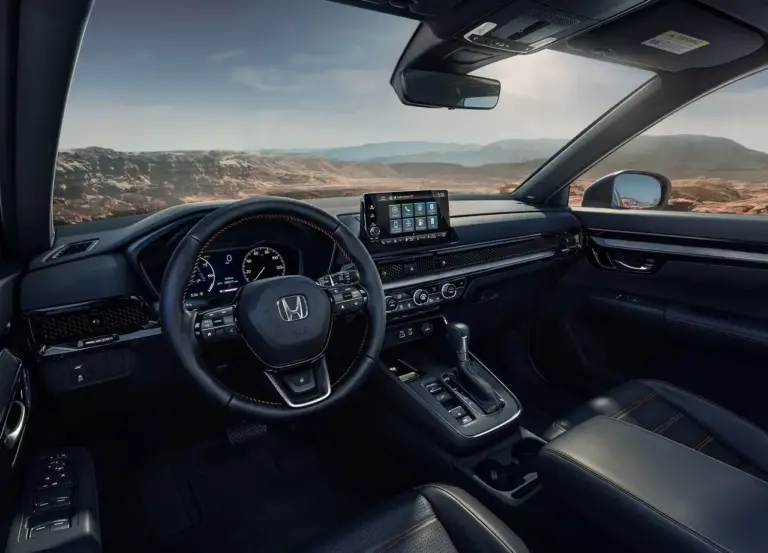
The 2026 Escape uses an 8-inch touchscreen on Active and ST-Line. The ST-Line Elite steps up to a 13.2-inch touchscreen with navigation and a 12.3-inch digital cluster. Wireless Apple CarPlay and Android Auto are standard. The CR-V uses a 9-inch touchscreen across the range with wireless smartphone integration, plus a 10.2-inch digital cluster on EX-L and above.
The CR-V comes with the Honda Sensing suite, including adaptive cruise control, on every trim. On the Escape, Ford’s more advanced Co-Pilot360 Assist+ package is standard on the ST-Line Elite and Plug-in Hybrid. Neither the 2026 CR-V nor the 2026 Escape appears on the IIHS 2026 Top Safety Pick list; the CR-V scored Poor in the updated moderate overlap test for rear-seat protection. Check iihs.org for the exact model year you are considering.
Cost of Ownership
The CR-V’s biggest ownership advantage is value retention. CR-Vs have a long record of strong resale, which we cover in Honda CR-V resale value. A discontinued model like the Escape may lose value faster, which hurts when you sell but helps when you buy. That is the case for a discounted leftover or used Escape: if the price reflects the risk, you can get a well-equipped SUV for less.
Fuel costs are close if you compare like with like. The CR-V Hybrid (37 mpg AWD) and Escape Hybrid (39 mpg AWD) are similar, and the base gas engines are both rated around 30 mpg with FWD. The 2.0-liter Escape costs more to fuel at 26 mpg.
Which Should You Buy?
- Buy the CR-V if you want a new compact SUV with a long production future and strong resale value.
- Buy the CR-V if you need maximum cargo space or roomy rear seats without sliding anything.
- Buy an Escape if you tow up to 3,500 lb and want a compact SUV rather than a midsize one.
- Buy an Escape Plug-in Hybrid if your daily commute fits within about 27 miles and you can charge at home.
- Buy a used or leftover Escape if it is priced well below a comparable CR-V. Use our used CR-V buying guide to compare against a used CR-V at the same budget.
FAQ
Is the Ford Escape discontinued?
Yes. Ford ended Escape production in December 2025, and 2026 was the final model year. Remaining new inventory had mostly sold through by fall 2026.
Is it safe to buy a Ford Escape now that it is discontinued?
Yes, Ford dealers will continue to provide parts, recalls and service. The main risks are lower resale value and fewer new units to choose from.
Which tows more, the CR-V or the Escape?
The Escape. With the 2.0-liter engine and towing package it is rated for 3,500 lb, compared with up to 1,500 lb for the gas CR-V.
Which has more cargo space?
The CR-V. It offers up to 76.5 cubic feet with the rear seats folded versus 65.4 cubic feet in the Escape.
Conclusion
The Escape had real strengths, including a powerful 2.0-liter turbo, a plug-in hybrid and towing capacity tied for the class lead, but its production is over. The CR-V is the safer long-term purchase, with more cargo room, a comfortable ride and better expected resale. Consider an Escape only when the price clearly reflects its discontinued status, and confirm current pricing with dealers.