Honda CR-V vs Chevrolet Equinox: Which Is the Better Buy?
The Honda CR-V is the better buy for most people: it is more fuel efficient, roomier inside, and offers a hybrid that the Equinox does not. The Chevrolet Equinox makes sense if you want the lower sticker price, a big standard touchscreen and bold styling, and you drive few enough miles that its lower fuel economy does not matter much.
Chevrolet redesigned the Equinox for 2025, and the 2027 model adds an 8-speed automatic for front-drive versions. The CR-V carries over for 2027 with small price increases. Here is how the two compare on the things that affect your wallet and your daily drive.

2027 Honda CR-V vs 2027 Chevrolet Equinox: Key Specs
| Spec | 2027 Honda CR-V | 2027 Chevrolet Equinox |
|---|---|---|
| Starting price (incl. destination) | From approx. $33,070 (LX FWD) | From approx. $30,995 (LT FWD) |
| Powertrains | 1.5L turbo 4-cyl, CVT; 2.0L two-motor hybrid, eCVT | 1.5L turbo 4-cyl, 8-speed automatic |
| Horsepower / torque | 190 hp / 179 lb-ft (gas); 204 hp / 247 lb-ft (hybrid) | 175 hp / up to 203 lb-ft |
| EPA combined mpg | 30 FWD / 29 AWD (gas); 40 FWD / 37 AWD (hybrid) | Approx. 26 (FWD and AWD) |
| Cargo, rear seats up | 39.3 cu ft (gas); 36.3 cu ft (hybrid) | Approx. 30 cu ft |
| Cargo, rear seats folded | 76.5 cu ft (gas) | 63.5 cu ft |
| Max towing | Up to 1,500 lb (gas); up to 1,000 lb (hybrid) | Up to 1,500 lb |
| Length | 184.8 in | 183.2 in |
| Seating | 5 | 5 |
Prices are approximate starting MSRPs including destination ($1,995 for the Equinox) and change during the year. 2027 fuel economy figures are early estimates or carry-over ratings; confirm on fueleconomy.gov and with your dealer.
Trims and Pricing at a Glance
The Equinox keeps its lineup simple, with three trims. The LT starts at about $30,995, and the sporty RS and rugged-look Activ both start at about $35,895. Every trim can be ordered with FWD or AWD, and AWD adds $2,000.
The CR-V spreads its range wider. Gas models run from the LX (about $33,070) through the EX (about $35,100) and EX-L (about $37,350). Hybrids start with the Sport Hybrid at about $37,580 and climb to the TrailSport Hybrid (about $40,750) and Sport Touring Hybrid (about $44,500). In practice, an Equinox RS or Activ lines up most closely with a CR-V EX on price, while the CR-V Hybrid trims have no direct Equinox rival.
Driving and Powertrains
Both base engines are 1.5-liter turbo fours, but they feel different. The Equinox makes 175 hp, and for 2027 every version uses an 8-speed automatic, which gives it a conventional, stepped feel that some drivers prefer to a CVT. The CR-V’s 190-hp turbo uses a CVT and is the slightly stronger of the two gas engines.
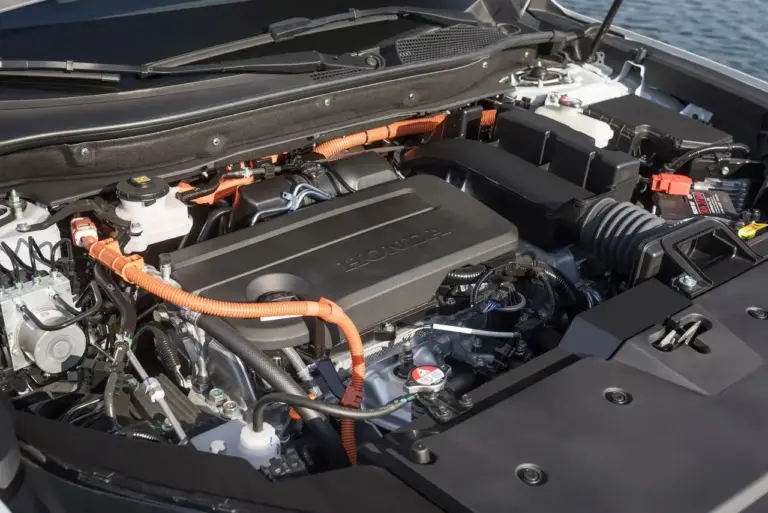
The real gap is the hybrid. The CR-V Hybrid’s 204 hp and 247 lb-ft give it the strongest low-speed response in this comparison, and Chevrolet does not offer a gas-electric Equinox. (The Equinox EV is a separate, fully electric model with a different price range.) For a sense of how the CR-V’s engines behave in daily driving, see Honda CR-V real-world acceleration and handling.
Both offer all-wheel drive. Chevrolet charges $2,000 for AWD on any Equinox trim; Honda charges $1,500 on gas CR-Vs, includes it on the TrailSport and Sport Touring Hybrids, and offers it on the Sport and Sport-L Hybrids. The Equinox Activ is Chevrolet’s rugged-look trim, comparable in spirit to the CR-V TrailSport Hybrid.
Fuel Economy
This is where the CR-V pulls clearly ahead. A front-drive gas CR-V is rated 30 mpg combined, about 4 mpg better than the Equinox at roughly 26. The CR-V Hybrid with FWD is rated 40 mpg, about 14 mpg better.
Over 15,000 miles a year, an Equinox at 26 mpg uses about 577 gallons; a gas CR-V at 30 uses 500; and a CR-V Hybrid at 40 uses 375. At an illustrative $3.50 per gallon, that is roughly $270 a year saved with the gas CR-V and about $700 a year with the hybrid. Over five years, the hybrid’s fuel savings can cover much of its higher purchase price. Our Honda CR-V fuel economy guide covers real-world tips.
Space and Comfort
The two SUVs are nearly the same length, but the CR-V uses its space better. Behind the rear seats, the gas CR-V offers 39.3 cubic feet versus about 30 in the Equinox, roughly 30 percent more. With the seats folded, the CR-V has 76.5 cubic feet versus 63.5. That is the difference between fitting a large dog crate and a week of luggage, or choosing between them.
Rear-seat room favors the CR-V as well, with 41.0 inches of legroom; the Equinox offers about 40 inches. Both have good front-seat space. For measurements by year, see Honda CR-V interior space.
Technology
The Equinox wins on screens. Every 2027 Equinox has an 11.3-inch touchscreen, larger than the CR-V’s standard 9-inch unit. Both offer wireless Apple CarPlay and Android Auto. The CR-V adds a 10.2-inch digital instrument cluster on EX-L and higher trims, and the Sport Touring Hybrid adds Google built-in and Bose audio. If the big center display is a priority, the Equinox delivers it at a lower price.
Safety
Both SUVs come standard with a suite of driver-assistance features, including automatic emergency braking and lane-keeping assist (Honda Sensing on the CR-V; Chevy Safety Assist on the Equinox). Neither the 2026 CR-V nor the 2026 Equinox is listed among IIHS 2026 Top Safety Pick winners. The 2026 CR-V scored Good in the small overlap front and side tests but Poor in the updated moderate overlap test, which looks at rear-seat passenger protection. Check iihs.org and nhtsa.gov for the current model year. Our Honda CR-V crash test article has more detail.
Cost of Ownership
The Equinox starts about $2,000 lower (LT FWD vs CR-V LX FWD), and Chevrolet dealers often add incentives. Both brands provide 3-year/36,000-mile basic and 5-year/60,000-mile powertrain warranties.
Over time, the CR-V tends to close the price gap through lower fuel costs and strong resale value. CR-Vs have a long track record of holding their value, which we cover in Honda CR-V resale value. If you lease, compare the monthly payment rather than the sticker price, since residual values and incentives drive lease costs.
Which Should You Buy?
- Buy the CR-V if you drive more than about 12,000 miles a year; the fuel savings add up quickly.
- Buy the CR-V Hybrid if you want the best fuel economy and the smoothest, quickest powertrain of the two.
- Buy the CR-V if you need maximum cargo room for family trips, sports gear or pets.
- Buy the Equinox if you want the lowest entry price and a large standard touchscreen.
- Buy the Equinox if you prefer a traditional automatic transmission over a CVT and do not drive many miles.
FAQ
Is the Honda CR-V bigger than the Chevy Equinox?
Slightly longer on the outside (184.8 vs 183.2 inches) and noticeably bigger inside: 39.3 cubic feet of cargo space behind the rear seats in the gas CR-V versus about 30 in the Equinox.
Does the Chevrolet Equinox come as a hybrid?
No. The gas Equinox uses only a 1.5-liter turbo engine. Chevrolet sells the Equinox EV as a separate all-electric model.
Which gets better gas mileage, CR-V or Equinox?
The CR-V. A front-drive gas CR-V is rated 30 mpg combined versus about 26 for the Equinox, and the CR-V Hybrid reaches 40 mpg with FWD.
Can both tow the same amount?
The gas CR-V and the Equinox are both rated to tow up to 1,500 lb. The CR-V Hybrid is rated up to 1,000 lb.
Conclusion
The Equinox is a stylish, well-equipped SUV with a low starting price and a big screen. The CR-V is the more complete package, with more cargo room, better fuel economy and a hybrid option that saves real money over time. Drive both, load your typical gear, and compare out-the-door quotes, since prices and incentives change often.