Honda CR-V Spark Plugs: Type, Gap and Interval
Every Honda CR-V since 2002 uses iridium-tipped spark plugs. On Maintenance Minder models, the car tells you when to replace them: they are part of service sub-item “4”. Older 2.4L CR-Vs specify a 1.0–1.1 mm (0.039–0.043 in) gap. The 1.5L turbo uses an NGK Laser Iridium plug that comes pre-gapped from the factory and should not be adjusted.
Below are the factory plug types and Honda part numbers for each generation, what the replacement interval really means, and how to change them yourself.

Honda CR-V Spark Plug Types by Model Year
| Model Years | Engine | NGK Plug | Denso Plug | Gap |
|---|---|---|---|---|
| 1997–2001 | 2.0L | ZFR6F-11 | KJ20CR-L11 | 1.1 mm (0.04 in) |
| 2002–2006 | 2.4L | IZFR6K-11 | SKJ20DR-M11 | 1.0–1.1 mm (0.039–0.043 in) |
| 2007–2011 | 2.4L | IZFR6K11 | SKJ20DR-M11 | 1.0–1.1 mm (0.039–0.043 in) |
| 2012–2014 | 2.4L | ILZKR7B-11S (Honda 12290-R40-A01) | SXU22HCR11S (Honda 12290-R40-A02) | 1.1 mm (pre-gapped) |
| 2015–2016, and 2017–2019 LX | 2.4L direct injection | DILKAR7H11GS (Honda 12290-RDF-A01) | DXE22H (Honda 12290-5A2-A02) | Pre-gapped; see manual |
| 2017–2022 | 1.5L turbo | ILZKAR8J8SY (Honda 12290-5PA-A01) | — | Pre-gapped, about 0.8 mm |
| 2023–present | 1.5L turbo | Honda 12290-6A0-A01 (NGK) | — | Pre-gapped |
| 2020–2022 | 2.0L Hybrid | DILZKAR7D11S (Honda 12290-6C1-A01) | — | Pre-gapped |
| 2023–present | 2.0L Hybrid | DILZKAR7G11Y (Honda 12290-6MA-J01) | — | Pre-gapped |
Plug types for 1997–2011 come from Honda owner’s and service manuals. Later part numbers come from Honda’s parts catalog. For 2012–2014, the “-11” suffix is NGK’s code for a 1.1 mm gap. Every engine takes four plugs. Honda sometimes supersedes part numbers, so confirm with your owner’s manual or a VIN lookup at a Honda parts counter before ordering.
Why You Shouldn’t Regap Iridium Plugs
Iridium and laser-iridium plugs have a very fine center electrode, often less than 1 mm across. Prying the ground strap with a gap tool can crack the ceramic or damage the precious-metal tip. Honda’s own service manual for the third-generation CR-V states plainly: do not adjust the gap of iridium-tip plugs. If a new plug’s gap is out of spec, replace the plug instead.
For the 1.5L turbo, the factory gap is tighter than on the 2.4L, at roughly 0.8 mm (0.031 in). A turbocharged engine needs more voltage to fire the spark under boost, and a smaller gap helps. Some aftermarket plugs sold for this engine arrive with a slightly different gap, which is another reason to stick with the OEM NGK part.
Spark Plug Replacement Interval
Minder-equipped CR-Vs: follow the code
Starting during the third generation (MOTOR magazine dates the CR-V’s switch to the 2008 model year), US CR-Vs use the Maintenance Minder instead of a fixed mileage chart. If your owner’s manual has a Maintenance Minder section, this applies to you. When the display shows sub-item 4, Honda’s owner’s manual says to replace the spark plugs and inspect valve clearance. The system calculates timing from engine operating conditions, so there is no single fixed number. Owners commonly see code 4 at around 100,000 miles, but severe use can bring it sooner. Our guide to CR-V Maintenance Minder codes explains every code.
Earlier CR-Vs: check the printed schedule
Older CR-Vs without the Minder use a printed maintenance schedule in the owner’s manual with separate normal and severe-condition intervals. Use the chart for your exact year, because plug material changed from the first to the second generation.
Signs plugs are due early
- Rough idle or a shake at stoplights
- Hesitation or stumbling under acceleration, especially on the turbo engine under boost
- A flashing check engine light or misfire codes P0300–P0304. See our CR-V check engine light codes guide
- Harder starting or a noticeable drop in fuel economy
On the 2017–2022 1.5L turbo, fuel dilution of the engine oil is a separate known issue on this engine. Our 1.5T oil dilution article covers it.
How to Replace Honda CR-V Spark Plugs
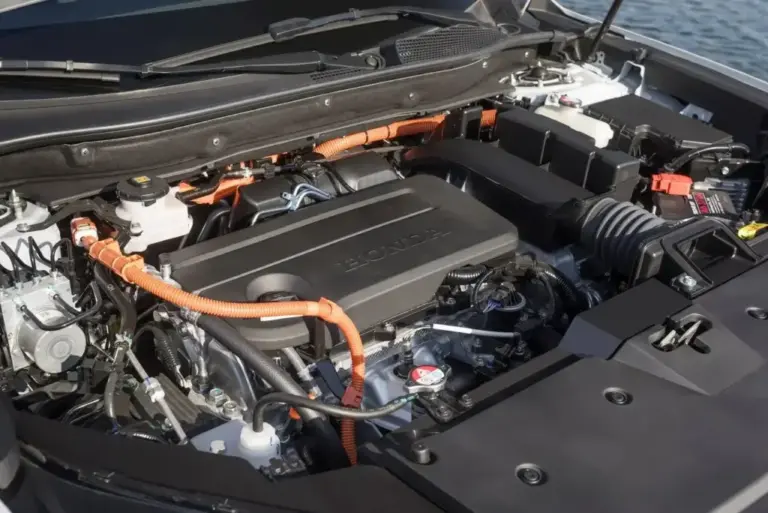
On every CR-V since 2002, the plugs sit on top of the engine under individual ignition coils, so this is one of the easier tune-up jobs. The 1997–2001 2.0L uses spark plug wires instead of coil-on-plug, so on those models you pull each plug wire boot rather than a coil. Work on a cold engine; aluminum cylinder heads strip easily when hot.
- Get the right parts and tools. Buy four plugs of the type listed for your engine. You need a ratchet, a short extension, a spark plug socket with a rubber insert, a socket for the coil bolts, and a torque wrench. The 1997–2001 2.0L uses a 16 mm (5/8 in) plug socket. The 1.5L turbo’s NGK plug has a 14 mm hex, so it needs a thin-wall 14 mm plug socket.
- Remove the engine cover. Most newer CR-Vs have a plastic cover over the coils that pulls or unbolts off.
- Clean around the coils. Blow out dirt and debris with compressed air so nothing falls into the cylinder when a plug comes out.
- Remove one coil at a time. Press the tab to unplug the coil connector, remove the coil bolt, and pull the coil straight up with a slight twist.
- Remove the old plug. Turn it counterclockwise with the plug socket and extension. Check its condition: tan or light gray deposits are normal, while oily or black and sooty tips point to other problems.
- Thread the new plug in by hand. Start it with just the socket and extension, or a piece of rubber hose, so you can feel cross-threading before it does damage.
- Torque to spec. Honda’s service data for the 2.4L K-series lists 18 N·m (13 lb-ft). Confirm the figure for your engine in a service manual. Over-tightening can damage the threads in the aluminum head.
- Reinstall the coil and connector. Make sure the coil boot seats fully on the plug, then repeat for the remaining cylinders. Do one cylinder at a time to avoid mixing up connectors.
- Start and check. The engine should idle smoothly. Clear any stored misfire codes, and reset the Maintenance Minder sub-item if it was showing.
For a broader look at what you can do at home, see our DIY CR-V maintenance guide.
FAQ
What spark plugs does a 2019 Honda CR-V use?
It depends on the engine. The 2019 LX with the 2.4L uses NGK DILKAR7H11GS (Honda 12290-RDF-A01) or Denso DXE22H. The EX, EX-L and Touring with the 1.5L turbo use NGK ILZKAR8J8SY (Honda 12290-5PA-A01).
Can I use copper or platinum plugs in my CR-V?
It isn’t recommended for any 2002-or-later CR-V. These engines were designed for iridium plugs, and the long Maintenance Minder intervals assume iridium wear rates. A cheaper plug would need replacing far more often and can misfire.
Does the CR-V Hybrid need spark plug changes?
Yes. The 2.0L engine in the CR-V Hybrid is a conventional gasoline engine with four plugs. Replace them when the Maintenance Minder shows code 4, just as on the gas models.
Should I replace the ignition coils at the same time?
Only if one is faulty. Coils don’t have a scheduled interval. If you have a misfire on one cylinder, swap that cylinder’s coil with a neighbor and see whether the misfire follows the coil before buying parts.
The Bottom Line
Use the OEM-equivalent iridium plug for your engine: IZFR6K-11 on 2002–2011 CR-Vs, ILZKR7B-11S on 2012–2014, DILKAR7H11GS on the 2015–2019 2.4L, and ILZKAR8J8SY on the 2017–2022 1.5L turbo. Install them without regapping and torque them correctly. Replace them when the Maintenance Minder shows code 4 or a misfire appears. Confirm the part for your exact year in your owner’s manual, and see our CR-V maintenance schedule for the rest of your service plan.