Honda CR-V TPMS Light Flashing or Won’t Reset: Fixes
If your Honda CR-V’s TPMS light stays on after you set the tire pressures, the usual reasons are a calibration that never finished, a tire that is still low when cold, or a fault in the system itself. A light that flashes for about a minute at startup and then stays on is a system malfunction, not a low tire. What fixes it depends on which type of TPMS your CR-V has, and that changed between generations.
For the menu-by-menu reset steps on each model, see our guide on how to reset the tire pressure light on a Honda CR-V. This article covers what to do when the normal reset does not work.

Which TPMS Does Your CR-V Have?
Honda has used two different systems on the CR-V. A direct system uses a pressure sensor inside each wheel. An indirect system has no tire sensors; it uses the ABS wheel speed sensors to spot a tire that is spinning faster because it has lost air and shrunk slightly in diameter.
| Model years | TPMS type | How the light is cleared | Typical failure |
|---|---|---|---|
| 2006 and earlier | Generally no TPMS | Not applicable | Not applicable |
| 2007–2013 (3rd gen and early 4th gen) | Direct, sensor in each wheel | Clears automatically once pressures are correct and you drive; new sensors need a scan tool to register | Dead sensor batteries, damaged sensors, wheels without sensors |
| 2014–2022 (later 4th gen and 5th gen) | Indirect, uses ABS wheel speed sensors | Manual calibration via TPMS button or vehicle settings menu, then driving | Calibration not completed, mismatched tires, wheel speed sensor fault |
| 2023 and newer (6th gen) | Indirect | TPMS calibration in the touchscreen settings, then driving | Calibration not completed, mismatched tires |
Your owner’s manual confirms which applies. If it describes a “TPMS calibration” procedure, you have the indirect system.
Steady Light vs Flashing Light
- Steady light: at least one tire is low, or on indirect systems, the system has not been calibrated to the current pressures.
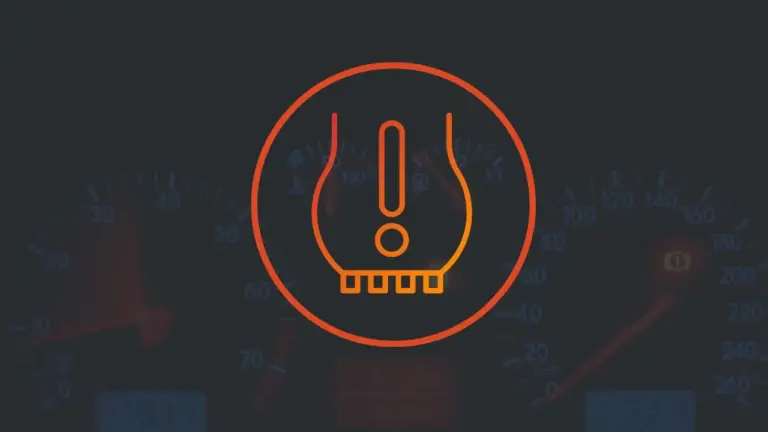
- Flashes for about a minute, then stays on: the TPMS has a fault and is not monitoring your tires. On direct systems this is often a failed sensor. On indirect systems a stored fault code puts the system into fail-safe mode.
- Brief flash at startup, then off: normal bulb and system check.
Our list of Honda CR-V dashboard symbols shows what the TPMS warning looks like on each generation.
Step-by-Step: When the Light Won’t Go Out
- Check all four tires cold, before driving or after the car has sat for a few hours, with a reliable gauge. Do not trust a visual check.
- Set each tire to the pressure on the driver’s door jamb label, not the maximum on the tire sidewall. Our CR-V tire pressure guide lists the values by year.
- Confirm all four tires are the same size and type and that the compact spare is not on the car. Indirect systems cannot calibrate with the spare fitted.
- On 2014 and newer models, park, put the transmission in Park, switch the ignition to ON and start TPMS calibration from the TPMS button or the vehicle settings menu.
- Drive. Indirect calibration needs roughly 20–30 minutes of cumulative driving at about 30–65 mph, depending on the model year. Calibration pauses when you drive outside that range.
- On 2007–2013 models with sensors, drive above about 28 mph for several minutes. The system needs to receive a fresh reading from each sensor.
- If the light still stays on, or flashes at startup, have a tire shop or dealer scan the TPMS for fault codes.
Common Reasons the Light Stays On
Cold weather pressure drop
Tire pressure drops roughly 1 psi for every 10°F fall in temperature. A tire set to spec on a mild afternoon can be several psi low on a frosty morning, which is why the light often appears with the first cold snap. Re-check and re-inflate cold, then recalibrate if you have the indirect system.
Calibration started but never completed
On indirect systems, calibration is not instant. Stop-and-go driving, short trips or long stretches above highway speed can leave it unfinished. Honda notes that if the vehicle is not driven soon after the ignition is cycled during calibration, the indicator may come on briefly; this is normal until calibration finishes.
Mismatched or new tires
Because indirect TPMS compares wheel speeds, one new tire with a different tread depth, a different brand, or the wrong size can confuse it. After any tire replacement or rotation, recalibrate. If you are buying tires, our CR-V tire size guide lists the correct sizes.
Dead or damaged sensors on 2007–2013 models
Direct TPMS sensors run on sealed internal batteries, and on CR-Vs of this age many original sensors have reached the end of their life. Sensors can also be damaged by tire sealant used to fix a puncture, or by careless tire mounting. Aftermarket winter wheels without sensors will also trigger the warning. On these models, a new sensor has to be registered to the TPMS control unit with a scan tool, so this is a tire shop or dealer job.
According to Honda service information reported by Modern Tire Dealer, the 2007–2013 system warns when a tire falls below about 24 psi and clears once it is above about 28 psi with the vehicle moving faster than 28 mph.
System faults on indirect models
Because indirect TPMS relies on the ABS wheel speed sensors, a fault in those sensors or their wiring can disable it. Disconnecting the battery will not clear TPMS fault codes. A shop needs to read and clear them with a scan tool after fixing the cause.
Habits That Prevent False Warnings
- Check pressures monthly and before long trips, always cold, and keep a good gauge in the glove box.
- Recalibrate every time you change pressures, rotate tires or fit a new tire on 2014 and newer models. Calibrating at the wrong pressure teaches the system the wrong baseline.
- Replace tires in sets where possible, or at least in axle pairs of the same model and size.
- Tell the tire shop your CR-V has direct TPMS if it is a 2007–2013 model, so they handle the sensors carefully and avoid sealant.
- Re-check after big temperature swings in spring and fall, when the readings move the most.
FAQ
Can I drive with the TPMS light on?
You can drive carefully to check the tires, but a steady light means at least one may be under-inflated, which hurts braking, handling and tire life. Check pressures as soon as possible. A flashing light means the system is not monitoring your tires, so check them manually until it is repaired.
Why does my CR-V’s TPMS light come on every winter?
Cold air lowers tire pressure. A tire that is slightly low in fall can cross the warning threshold on the first cold morning. Top up to the door-label pressure measured cold, then recalibrate on indirect systems.
Does the indirect system catch all four tires being low?
Not reliably. It compares the tires with each other, so if all four lose air at the same rate, the difference may be too small to trigger the warning. Check pressures with a gauge at least once a month.
Do I need new TPMS sensors for winter wheels?
Only on CR-Vs with direct TPMS (2007–2013). Those wheels need their own sensors registered to the car, or the light will stay on. On 2014 and newer models with indirect TPMS, there are no wheel sensors to buy; just recalibrate after fitting the wheels.
Conclusion
Most CR-V TPMS lights that will not go out come down to an unfinished calibration, a tire that is still low when cold, or mismatched tires. On 2007–2013 models, dead wheel sensors are the other usual cause. A light that flashes before staying on means a system fault, so have a tire shop or Honda dealer scan it. For tire choices that suit this SUV, see our Honda CR-V tire recommendations.